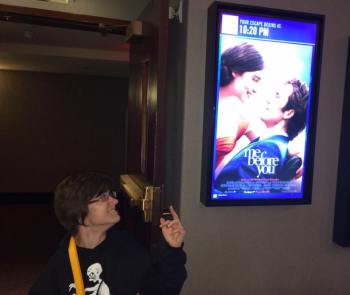
 To all of the millions of people who think Me Before You is a touching love story, those who applaud Will Traynor’s ‘bold’ choice to take his life –and death- into his own hands… you need to have your heads examined. To be sure, ardent fans of this story cannot comprehend the dangerous and disturbing connotations of its plot. So being the kind person that I am, I’ll spell it out for you.
Let me start by making a few things perfectly clear. First, I made sure to see the movie before writing this, so I’m not grasping at straws –I’ve read extensive synopses of the book as well. Second, I am a person with a disability who supports the right to physician-assisted suicide for terminally ill patients facing imminent and painful deaths –the key words there are terminally ill, but I’ll get back to that later. Lastly, I have absolutely no scruples about able-bodied actors playing disabled characters; I believe that when actors commit to telling our stories and they portray us with dedication and respect, transformations are amazing and we gain allies in those who’ve made an effort to understand the view from where we sit –Eddie Redmayne in The Theory of Everything, James McAvoy and Steven Robertson in Rory O’Shea Was Here, Michael Sheen in Music Within, Daniel Day-Lewis in My Left Foot, John Hawkes in The Sessions, William H. Macy in Door to Door (to name a few).
Me Before You cannot be included in the above list; its portrayal of disability mixes inspiration porn with tragedy porn; it’s a disgusting insult to the lives that the majority of us live –the lives we fight for. Not only is it an insult to people with disabilities, it also manages to simultaneously insult our families, our caregivers and our struggles.
People who acquire spinal cord injuries and suddenly find themselves living with paralysis face very real and complex battles with depression and thoughts of suicide. They grapple with facing a new reality, knowing that they’ve lost parts of themselves and they must fight to reconcile who they were before with who they are now; they must grieve the loss of their pre-injury identity and find their enduring sense of self.
The movie opens showing virile, strong, gorgeous Will Traynor in bed with a woman. As he gets up to start his day, the camera is sure to pan in on his hands as he buttons his shirt and ties his shoes –spoiler alert, soon he won’t be able to do that anymore; I wonder if director Thea Sharrock went to the Captain Obvious School of Filmmaking? Will’s girlfriend implores him not to ride his motorcycle to the office because it’s pouring. He obliges and steps outside in the rain, into the street and is struck head-on by –you guessed it- a motorcycle.
Emilia Clarke plays Louisa Clark (Lou), the classic, quirky, weird, upbeat underachiever in a family that’s apparently struggling to make ends meet; most of Lou’s paychecks are given to her parents in order to help them stay afloat. I say ‘apparently’ because for a family that garnishes the wages of their daughter to help pay the bills, Lou has an impressive number of designer shoes and bags.
Cut to Lou sitting in a temp agency, whining about all the things she’s tried that just aren’t her cup of tea when suddenly they find a listing requesting ‘care and companionship for disabled man’. ‘Care and companionship for disabled man’ is a job description that makes me want to gag, but that’s beside the point.
Lou goes to the Traynor estate (they live in a castle, how convenient) to interview for the job with Will’s mother. Lou mistakenly assumes that the disabled man in question must be her husband; when Mrs. Traynor clarifies that Will is her son, Lou goes ashen –she gives a very convincing portrayal of a narrow-minded twit who’s been living under a rock, having not even considered that it would be possible for someone under the age of sixty-five to have a disability. What’s worse –does she do anything to mask her mouth agape look of shock? Of course not! In the awkward exchange that follows, Mrs. Traynor asks Lou if she knows what a quadriplegic is. What a quadriplegic is? Her question should be if Lou knows what quadriplegia is; a person who has quadriplegia is referred to as a quadriplegic.
No wonder Will wants to die –as if his depression wasn’t enough of a challenge, his mother is conducting interviews wherein by explaining her son’s circumstance, she’s stripping him of his personhood.
Lou responds by saying, ‘When … you’re stuck in a wheelchair?’ Bravo, brain trust. Mrs. Traynor explains that Will has lost all use of his legs and only has limited use of his arms and hands and asks Lou if that would bother her. Lou, already established as a brilliant wordsmith, says, ‘Well, not as much as it would bother him, obviously … Sorry –I didn’t mean –’ That’s a pretty disgustingly inappropriate thing to say in an interview to be someone’s caregiver, even if it slips out because of nervousness. As someone who hires, employs and fires her own attendants, if anyone said that to me or about me, I’d thank them for coming and show them the door.
But this is the movies! Lou was hired on the spot and brought to Will’s annexe to meet him. Will has an annexe at the castle which has been renovated to be totally state-of-the art and wheelchair accessible; I’m pretty sure no one with any disability is lucky enough to have a millionaire’s means and strangely, most of us still want to live, go figure.
At her first day on the job, Will’s nurse shows Lou his medications. She balks at the idea of having to handle meds. By this point, even though it’s still early on, Will’s struggles with debilitating, chronic pain are made explicitly clear and yet his nurse tells her, ‘If he complains of pain, try not to give him painkillers or sleeping pills unless it seems really bad and even then, only one.’ Presumably he’s telling her this because of Will’s past suicide attempt –there are scars on his wrist, but how could that be, when the man can’t move his arms? Am I supposed to believe that he can’t feed himself, but he can somehow brandish a knife? Nonetheless, valid advice –don’t overdo meds with someone who’s suicidal. But seriously? Number one, Will has no movement in his arms and only limited movement in his fingers, so if the medication is in a bottle, which is kept in a cupboard, how exactly is he going to overdose? Number two, you’ve established that this man lives with unbearable physical pain and is constantly suffering and you want to siphon off his access to appropriate doses of medication? Good job. Again I say, no wonder the guy wants to die.
One night while Will is asleep, Lou is snooping around and picks up his laptop –which is conveniently not password protected, way to disrespect a guy’s privacy- and sees a video of him from his most recent birthday, strapping, bare-chested and diving off a cliff in a tropical paradise. Will wakes up and doesn’t give her hell for touching his personal property and being too nosy for her own good, but instead makes a joke about how she’d better be watching some good porn –which is of course, the most logical reaction to a busybody caregiver disrespecting your privacy and personal belongings.
Sam Claflin –oh Sam Claflin, I really wanted to see a glimmer of something, anything in his performance as Will Traynor so that I could give him his due –credit him with making an impossibly bad script easier to stomach. But sadly, I can’t. I don’t doubt that he did research in preparing for this role, but as I suspect is the case with everyone involved in this film, they did only the research that served the purposes of the movie –they probably spoke to people with disabilities who are struggling to find the will to live and patted themselves on the back for a job well done while conveniently ignoring the vast majority of us who don’t have a death wish.
I will say that Claflin does a good job at portraying the hopelessness and despair and depression that people with disabilities often face. The most glaring problem is that Will Traynor’s depression is never acknowledged on film –not once. This story had an amazing opportunity to explore issues of depression and suicide and be a real platform for discussions of mental health, but it didn’t even approach the topic.
Will wants to go to Switzerland, where he can obtain legally sanctioned assisted suicide because he can’t bear to live like this anymore –not being the person that he was. He says at every available opportunity that death is preferable to life in a wheelchair. He has scars on his wrist from a previous attempt at suicide and when the film opens, he’s made arrangements to go to Dignitas to die in six months’ time, after being a quadriplegic for two years.
Throughout the movie, you see the distress that his decision causes everyone around him, but the sentiment is ‘I want him to live, but only if he wants to live. He’s in pain, he hides it when Lou’s around, but he wakes up screaming sometimes.’ He’s depressed and suicidal and no mention is ever made of whether or not he’s ever received psychological or psychiatric help. Are we supposed to assume that he has and it didn’t work, so huzzah, onto death with dignity? Or has he never been treated for his depression at all? We never actually know.
Physician-assisted suicide is supposed to be for people who are terminally ill. I support physician-assisted suicide as a choice for terminally ill patients, who are no longer responding to treatment and are in the end stages of disease. Will has quadriplegia and chronic pain and health complications –he isn’t dying. Physician-assisted suicide should not apply to him as a legal right. I am squarely in the minority of disabled people who support physician-assisted suicide. I don’t fear it, nor do I think it gives people a licence to kill me. If, God forbid, one day I find myself facing death at the hands of a terminal illness, physician-assisted suicide is a choice that I want a legal right to. A law meant to provide dignity and autonomy to terminally ill patients, through their own choosing when all quality of life has been exhausted is not something that has any bearing on people with disabilities, or in fact anyone who isn’t dying.
However, the second physician-assisted suicide is granted to people who aren’t terminally ill, that’s a slippery slope in the wrong direction that sets a very dangerous precedent. Yes, Will is quadriplegic; yes, he’s suffered bouts of pneumonia and suffers from chronic pain, but am I supposed to believe that in 2016 (or 2012, to go by when the novel was released) there are no sufficient medical interventions that the best doctors in the UK could devise to manage his complications? Has he never seen a pain management specialist before? What treatments were discussed, attempted and failed so miserably that –just like psychiatric help for his depression- they aren’t even mentioned throughout the course of the film?
Lou is not made aware of Will’s plan to go to Switzerland when she’s hired. Mrs. Traynor tells her she’s there to keep him company and cheer him up. I’m pretty sure that’s not even legal; Lou could raise a serious shit storm with her employers for their utter lack of full disclosure. ‘Care and companionship for disabled man’ is in fact ‘palliative care for disabled man’. But, does Lou make an issue of this? Of course not!
As the movie progresses, we see Lou able to bring Will out of his shell. One day, they’re traipsing around castle grounds when Will takes her to the highest lookout on the property. Lou –at this point aware of Will’s death wish- sees him speeding towards a cliff and has a minor heart attack, thinking of course that he’s going to hurl himself off it –which would probably do the trick, no expensive trip to Switzerland required.
Will starts telling Lou about Paris and how much he loves it there. Lou suggests to him that they get on the train and go –after all, if he misses it why not go back? Will says, ‘I want to go to Paris as me, with girls giving me the eye. I don’t want to worry about a chair that won’t fit behind a table, or taxis that won’t take me where I want to go.’
First, ‘wanting to go to Paris as me’ is a valid train of thought for someone who’s obviously struggling to reconcile his new reality with who he used to be but, as was mentioned before, there is absolutely no discussion of what –if anything- has been done to treat Will’s depression. Perhaps if he were getting appropriate psychiatric and psychological help, it wouldn’t be so utterly impossible for him to entertain the notion that he is in fact still himself. I’m not saying it’s simple, or that his identity pre and post injury aren’t radically different in any number of ways, but his complete detachment from any sense of anything resembling an identity –even a radically different one- is very troubling. Second, Will Traynor’s a good-looking dude, he can attract normal women, not just crazies; someone should really tell him that quadriplegics can have sex. In fact, Lou is hopelessly in love with you by now, Will, she’ll bed you no problem and she even told her asshole of a boyfriend, ‘He can have sex, women just have to be on top,’ so there you go! Problem solved, she knows what to do already. Third, someone needs to let him in on the fact that accessible transit exists, beyond the chartered personal vehicles and private jets his family owns –dude can totally go to Paris, enjoy buttery croissants and get laid!
There is a scene where Lou gets tickets to a symphony and Will agrees to go only after complaining that they’re not for a Jay Z concert. Lou shows up to Will’s apartment wearing a beautiful red dress and Will is positively dashing in a tuxedo; the ooos and awws of people in the theatre made me feel like I was in a real-live laugh track for a sitcom. My friend and I noted that no way would there be such an audible reaction if one of the main characters weren’t disabled. I felt like yelling, “SERIOUSLY? You think he’s never seen a girl in a red dress before? He’s probably taken quite a few girls out of red dresses before. Shut up!”
Will takes Lou to his ex-girlfriend’s wedding, which is punctuated with close-ups of Will clenching his jaw and biting back tears, watching the woman he loved marry someone else. Then there were close-ups of Lou, biting back her own tears of agony and sadness at seeing Will’s distress. Here’s my question: why the hell would you go if you know it’s only going to serve as an exercise in emotional torture? Call me crazy, but if you can’t be happy for the woman and if going to her wedding will serve to do nothing but remind you of the one that got away and how badly you wish you were the one standing at the top of that altar, maybe you just don’t go.
At the reception, there’s a terribly awkward interaction between Will and his ex, before Lou asks him to dance. Just as a point of interest, the song they dance to is Ed Sheeran’s Thinking Out Loud, which is a great song, I love Ed Sheeran. But it’s worth noting that the first line of the song is ‘When your legs don’t work like they used to before’, which is kind of hilarious and given the disgustingness of this entire film, probably not an accident either; they probably planned that painstakingly. Will and Lou also share a slightly gross joke that all Will brought her for was to stare at her boobs, because after all, they are right at eye level. I’ve heard men with disabilities make that joke before and it’s obnoxious. It wouldn’t bother me so much if everything else about the film wasn’t so repugnant, but of course they had to make the boob joke too.
After the wedding, Will relents and lets Lou convince him that they should go on a trip. They jet off to a fantastic tropical location where Will forces Lou to try her hand at scuba diving even though she’s terrified –of course as soon as she dives in she positively loves it.
One night, there’s a severe thunderstorm rolling in over the water; Will is in bed and Lou is prancing around their room in a night shirt and no pants, which is odd considering she’s there as Will’s attendant. Shouldn’t she at least be wearing pants on the job? Seriously, someone needs to tell Will he can totally have sex. Hell, Lou’s already pantless –it would be so easy.
On the last night of their getaway, Will starts to confess to Lou that he has something to tell her. Finally, some honesty! Lou tells him she already knows what he was planning to do –she’s in fact known for months. Will, who’s remarkably less depressed than he was at the beginning of the film, tells Lou that he still plans to go to Switzerland. Lou is heartbroken, shocked to learn that she was not successful in changing his mind. Will tells her that no one could’ve changed his mind.
He’s a cripple exercising his free will and he chooses to die, damn it! Enough with this wanting him to live business!
Lou starts grasping at straws, saying ‘But I can make you happy,’ to which Will responds, ‘I don’t want you to be tied to me, to my hospital appointments, to the restrictions on my life. I don’t want you to miss out on all the things someone else could give you. And, selfishly, I don’t want you to look at me one day and feel even the tiniest bit of regret or pity that … You have no idea how this would play out. You have no idea how you’re going to feel even six months from now. And I don’t want to look at you every day, to see you naked, to watch you wandering around the annexe in your crazy dresses and not … not be able to do what I want with you. Oh, Clark, if you had any idea what I want to do to you right now. And I … I can’t live with that knowledge. I can’t. It’s not who I am. I can’t be the kind of man who just … accepts.’
And there it is, the inevitable conclusion that people with disabilities can’t have sex, that we shouldn’t want to; we should be suspicious of anyone who might be interested in getting physical with us, because can’t they see how disgusting we are?
I should also mention that in the novel, Lou is the victim of rape –something author Jojo Moyes mercifully left out of the screenplay. The novel’s context creates an even more problematic paradigm –the sexual abuse victim who conveniently falls in love with a man she never entertains the idea of having sex with. A man whom, because he’s disabled doesn’t seem aware of, or interested in the possibility of having sex or the idea that the woman he loves might be sexually attracted to him.
Will goes to Switzerland and of course a distraught Lou rushes to be by his side in time. By the time Lou arrives at Dignitas, Will has already taken whatever lethal drug they provide him with that eases him into the afterlife, because though he’s still conscious and coherent, we never see him take anything. The two platonic, non-sexual lovers share a brief tearful exchange and Will asks Lou to bring his parents in –who of course are there by his side as well.
Will’s death is signalled by the screen fading to white and a single green leaf falling from the sky, which lands on a bench in Paris –where Lou is for the film’s final vomit-inducing scene.
Will has left Lou money, allowing her to have the life and adventures she always wanted. She’s sitting in a quaint little café when a waiter appears out of nowhere and hands her a letter from Will. Disturbingly, he knows exactly where she is. Apparently, along with leaving her wealth for her freedom, he also left explicit instructions regarding how she should enjoy that freedom. He tells her what café she’s at, what she’s eating and he tells her what store to go to and what perfume to buy. Creepy much? This is another troubling and unmistakable message of, ‘See how much better off you are now that I’m dead? Look at this life that my death and my oodles of cash were able to afford you!’
Fans of this story will argue that this somehow doesn’t push the agenda that it’s better to be dead than disabled. It’s one person’s story! It’s not meant to speak for all disabled people! The author of this mess will tell you that herself. Her most ardent defense is that Will’s story is meant to be just that –one man’s journey, one man’s decision which is in no way meant to reflect an entire group of people. Will’s voice is not the voice of all disabled people. She will vehemently point out that almost everyone in the novel disagrees with Will’s decision to end his own life. She’s right; she’s also right that some people in Will’s position do want to die.
But the problem with her justification and that of the fans of the story who are quick to back her play is the key perspective that disagrees with Will that is suspiciously absent –the voices of other people with disabilities. Me Before You offers no other perspective on disability and what it’s like to live with. Will’s is the only voice we get and he is unwavering and unapologetic in his desire to die because he cannot abide living with a disability.
You know what would’ve been great, Ms. Moyes? Providing your readers with the other side of a loaded coin; that doesn’t mean your protagonist has to suddenly not be suicidal, but would it have been so hard to provide your audience –and indeed Will himself with proof that lots of people with disabilities want to live? Yes, in the novel, Lou does internet chartroom research, logging onto a message board asking how she can help her friend who wants to commit suicide and in the film she stumbles around a library cartoonishly, checking out and printing off every resource she can find about adaptive anything, hoping it will make Will want to live. But that’s hardly enough. It’s hardly enough that everyone who disagrees with Will’s wish to die is able-bodied and cannot possibly understand his anguish and pain –both physical and psychological. Perhaps if Will had people he could turn to who’ve faced similar situations and found the desire to live again, he might not have been so adamant that dying was his only choice.
Will’s choice is hardly the choice that most people in situations similar to his would make. This movie and its accompanying book are going to reap terrifying consequences on the collective public conscience. Moyes, Claflin, Clarke and Sharrock will argue that this film chronicles a courageous choice and attempts to discuss issues of assisted dying. As someone with a disability who supports physician-assisted suicide legislation, I can say unequivocally that what little this film is able to contribute to that discussion does so poorly, and at the expense of an unmistakable and truly dangerous message that it is better to be dead than disabled –and anyone who suffers, even a little at the hands of disability would do well to be like our dear Mr. Traynor and just give up –because after all, it’s courageous.
I’m a certified high school teacher. I’m not teaching right now, but I know beyond a doubt that this movie is making a good chunk of its profit off of teenaged girls. I’d bet what little money I have on the fact that if I were teaching right now, I’d have a student in one of my classes who would’ve asked me, “Hey, Miss, have you seen that movie? Have you ever thought of physician-assisted suicide like Will Traynor? If you have, that’s okay. If you’re in as much pain as he was, maybe you should.”
I hate that Will is seen as some sort of martyr for wanting to die –that millions of people applaud Moyes for writing a book and adapting a screenplay that sheds light on the importance of freedom of choice. She’s being thanked and cheered on the world over for creating a character with a disability that is ‘also sexy’ and has the bravery to make decisions about his own fate, regardless of what everyone else thinks.
I saw an interview recently where Moyes said that the most important thing about her story was to look past Will’s disability and see him as a person, to appreciate his outlook on life –which is really hard to do, considering he doesn’t have one- and to see that his disability is in fact the least interesting thing about him –which is also ironic, since the entire movie focuses on Will’s crushing depression and his inability to accept the idea that life in a wheelchair is not synonymous with death.
At the end of the day, if a movie were made about an able-bodied, depressed and suicidal person campaigning for the right to assisted-suicide there would be unanimous outcries of rage –that movie would never be made, much less loved. Physician-assisted suicide is serious; depression is serious; suicidal intention is serious; sustaining a spinal cord injury and dealing with the ramifications of that are serious. To me, the fact that Will Traynor is easy on the eyes is the last thing on my mind. His story is serious matter –I don’t really care if he’s sexy.
The film’s tagline is to live boldly. I do live boldly, by doing something that Will couldn’t find the strength and possibly wasn’t even given the appropriate psychological support to do –I live boldly by living.
 cutiemcscootie