I first saw Willia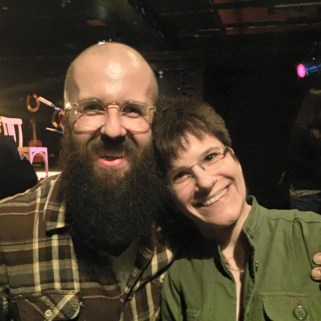 m Fitzsimmons in concert two years ago. When I met him after the show we talked about many things. I mentioned how grateful I was to be there –his concert the previous year took place at an inaccessible venue, so I couldn’t attend. He seemed a little shocked; he asked me what venue it was; I said I couldn’t remember. He promised to do his best to find out where it was and not play there again, because he wanted me to be able to be at his shows. I believed him wholeheartedly.
William Fitzsimmons is an artist who is unbelievably connected with and accessible to his fans. If you’ve met him at a show and you send him a Facebook friend request with a message about where you met, he’ll add you to his personal page –which is pretty amazing.
Last year, I saw him in concert again. When waiting in line to say hi, he couldn’t remember my name, but he knew right away that he’d met me before. He said, “Oh wow! You’re here! You got in! It’s so good to see you again, sweetheart!”
Yesterday, he announced his upcoming North American tour dates. I was thrilled to see Toronto on the list, but my excitement soon gave way to disappointment when a Google search of the venue –The Great Hall- told me unequivocally that the Victorian building was completely wheelchair inaccessible, like so many other historical sites in Toronto. The website said the venue was undergoing renovations, but I couldn’t find any details about what those renovations were or when they would be done.
I posted the following Facebook status, in which I tagged William Fitzsimmons: William Fitzsimmons is going on tour! Yay! He has a date in Toronto! Yay! … It’s at an inaccessible venue. Excuse me while I go blast his soft melodic tunes of heartbreak, a perfect soundtrack for weeping.
I Tweeted him as well, knowing that there was a chance he might respond; the worst that would happen was nothing –but it was worth a try. I was not about to ask for the venue to be changed on my account –I knew that’d be impossible- but I was hoping to bring some attention to the issue of inaccessible venues and how disappointing it is to find out you can’t go to a concert not because you can’t afford it, or because you’re busy, but because you literally can’t get in the door. Fitzsimmons plays tiny venues and as such, accessibility isn’t always a given –this was, after all, not the first time I was in the position of being forced to miss one of his concerts.
One of my friends commented on my Facebook status that I should contact Fitzsimmons or his management team. I was in the midst of composing an email to his management and North American booking agent –which I was cc’ing to a manger at the venue- when William Fitzsimmons himself commented on my status post, asking how he could help. I responded immediately, saying I understood that changing venues would prove impossible and I wouldn’t be able to attend unless someone was able to carry me in and out; all I was hoping for was that accessibility might register on the radar of those responsible for bookings, because being physically unable to get in was a terrible reason to have to miss a show. He sent me a private message right away, saying it was ridiculous that the venue was inaccessible and he saw on the website they were undergoing renovations. He said he would find out what was going on and what could be done; he’d get in touch with the venue and get back to me. I thanked him profusely and promised that if the venue was proven to be accessible, I’d be at his December concert with bells on.
I then went back to composing the email to his team and the venue. I had a response from one of his managers, Todd Walker, within the hour. Walker was confused –he thought that venues like that were required to be accessible and promised to keep it in mind in the future. I emailed back explaining that the United States has the Americans With Disabilities Act, which is binding law that does require public venues to meet standards of accessibility; Canada, I explained “does not have overarching accessibility laws that are comparable to the ADA and there is no blanket legislation that ensures accessibility of public venues. In cases of historical venues like The Great Hall, accessibility is often non-existent due to the age and history of the structure and renovations to make these places accessible are extremely slow in coming. I know that The Great Hall is currently undergoing renovations, but I do not know if those renovations include an elevator, or if they will be complete by December.”
About half an hour later, I got a response from Mark Foster –a production manager at The Great Hall, who told me that the venue had only recently become accessible about eight weeks ago, explaining, “the Hall is a heritage building, so unfortunately rules of accessibility don’t apply in the same way, being able to even become accessible took nearly 2 years of planning and navigating red tape of multiple departments with the city of Toronto, among our other restoration/renovation work.”
Accessibility in Canada is not a given. There’s red tape, bureaucracy, exemptions and loopholes. Canada’s Charter of Rights and Freedoms is more like strongly worded suggestion –it is not law. It states that individuals cannot be discriminated against on the basis of disability; but companies and corporations are only required to accommodate up to the point of ‘undue hardship’ and in the case of historic sites –as seen in the above excerpt from Foster’s email- even those loose, far too unspecific rules do not apply in the same way.
Luckily, this story has a happy ending. Thanks to a musician who is in tune with (no pun intended) and truly cares about his fans and his responsive management team, as well as a timely response from someone at the venue, not only was the issue addressed and taken seriously, but I in fact found out that I could indeed go to the concert. I did tell Foster that their website and Internet information needed to reflect their newfound accessibility; if I had trusted Google and their website without asking any questions, I’d be missing the show due to believing that I cannot get inside.
I was not wrong to have faith in William Fitzsimmons. I was not wrong to believe that his reaction of disappointment to the story I told him when we first met two years ago was genuine. I remember thinking when I saw him last spring, at a different venue than the first time I saw him, that maybe –just maybe- he really did remember our conversation and he had a small part in making sure this show also took place at an accessible venue. Given how accessible and connected to his fans he is, the fact that he plays small, intimate venues and he seems to be in full control of his own public profile, it is not unreasonable to believe that he may indeed have some say in which venues he plays at.
I probably would have arrived at the same positive outcome had I finished composing that email to management and the venue, without hearing from Fitzsimmons himself at all. But the fact is –I did. William Fitzsimmons reached out to me personally, to apologize and offer to look into the issue –and that’s huge. Here’s a man who truly cares, whose success does not eclipse his empathy or his humanity. One of the main reasons he is so loved among his devoted fans is because we’re seen, we’re heard, we’re remembered. To William Fitzsimmons, his fans have faces; we have names; we have stories. He respects us all; he acknowledges us.
I’m holding back tears as I finish writing this. There are no words to adequately express the gratitude I feel for the way things unfolded last evening, or how truly touched I am to have heard from William himself –to know that my struggle matters to him, because he doesn’t want me to be barred from his concerts.
To William, I say: You are a talented and beautiful soul -with a wicked sense of humour! Thank you for your music. Thank you for seeing me. Thank you for all that you do to ensure that I am not left behind. I promised to be at your concert with bells on –any idea where I can get me some bells? See you in December, good sir. I cannot wait.
 cutiemcscootie