Raise your hand if you’ve heard of the Principles of Universal Design
Accessibility isn’t just a checklist—it’s a mindset. This mindset begins with universal design.
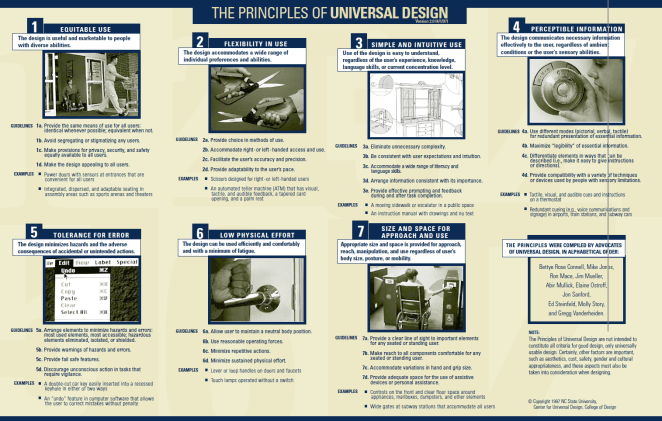
First introduced by a pioneering group of architects, product designers, engineers, and researchers at North Carolina State University, the Principles of Universal Design offer a powerful framework to ensure environments and products are usable by all people, to the greatest extent possible, without the need for adaptation or specialized design.
Here’s a quick tour of the 7 principles that guide this approach:
1. Equitable Use: Design should be inclusive and marketable to people with diverse abilities.
✅ Same means of use for all
✅ No segregation or stigma
✅ Equal access to privacy and safety
✅ Aesthetic appeal for everyone
2. Flexibility in Use: Supports a range of individual preferences and abilities.
✅ Choice in usage methods
✅ Right- or left-handed access
✅ Adaptable to pace, accuracy, and precision
3. Simple and Intuitive Use: Design should be easy to understand regardless of user experience or literacy level.
✅ Eliminate unnecessary complexity
✅ Align with expectations and intuition
✅ Use clear, well-prioritized information
✅ Provide helpful feedback
4. Perceptible Information: Communicate clearly across sensory differences and environments.
✅ Redundant modes (visual, tactile, verbal)
✅ High contrast and legibility
✅ Support for assistive tech
5. Tolerance for Error: Minimize hazards and consequences of mistakes.
✅ Prioritize safe, accessible placement of elements
✅ Include warnings and fail-safes
✅ Discourage unconscious errors
6. Low Physical Effort: Design should reduce fatigue and strain.
✅ Neutral body positions
✅ Minimal force, repetition, and exertion
7. Size and Space for Approach and Use: Everyone should have access, regardless of mobility, body size, or posture.
✅ Clear lines of sight
✅ Comfortable reach
✅ Space for assistive devices
Accessibility and universal design are inextricably linked. Designing for everyone isn’t just good practice—it’s essential. Let’s build spaces, products, and systems that empower all of us. Have you used these principles in your work? Connect with me to find out how I can help you bring these principles to life in your workplace.
 cutiemcscootie